
How To Knit The Diamond Cable Stitch (Free Stitch Pattern)
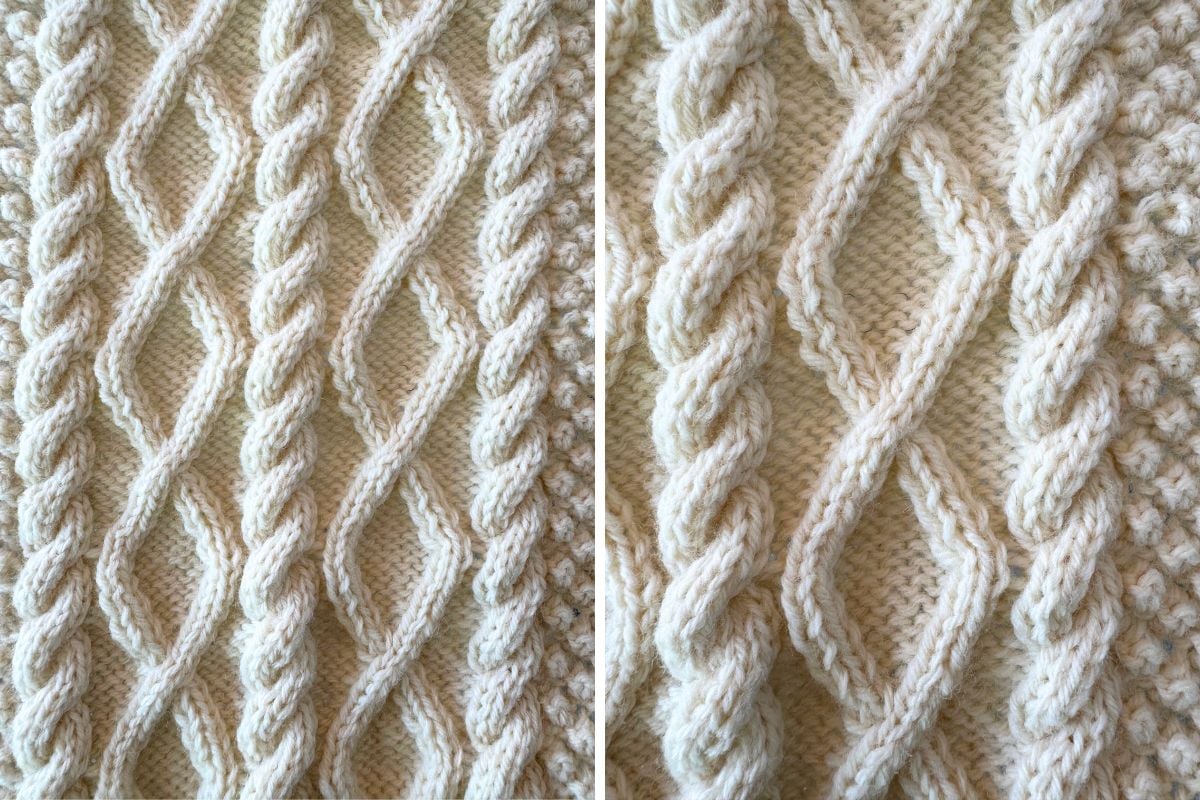
THIS ARTICLE CONTAINS AFFILIATE LINKS THAT SUPPORT HANDY LITTLE ME CONTENT AND FREE PATTERNS.The diamond cable stitch is a classic Aran cable pattern that creates raised, interlocking diamonds, a rich texture that looks gorgeous on sweaters, hats, and cable blankets.
This tutorial gives you clear instructions, helpful tips, and a clean pattern row-by-row so you can swatch the panel or plug it into a fully realized knitted project.
Scroll down for the free pattern instructions.
Save this article
Enter your email address and we'll send it to your inbox.
By entering your email, you agree to receive patterns, tutorials, and updates from Handy Little Me. Unsubscribe at any time.
Before You Get Started
A few things to know at a glance:
- Skill level: Intermediate – great if you’re ready for a new challenge or a “passion project.”
- Background: The diamond panel sits on a background of reverse st st (reverse stockinette).
- Tools: You’ll work standard knit stitches and purl stitches, and use a cable needle to cross stitches to the front/back.
- Sizing & gauge: Swatch first. For garments/blankets, match the gauge in your pattern. For practice, gauge isn’t critical.
- Reading the fabric: RS = right side (raised cables), WS = wrong side (purl background).
- Tip: Keep an even tension on WS rows – neat WS fabric makes the diamonds pop on the RS.
Tools/Materials
- Yarn: Any smooth yarn with good stitch definition (wool or cotton is great). For practice, try worsted/Aran weight yarn. ~20–30 g (≈ 20–30 meters) is plenty for a swatch.
- Needles: Size to suit your yarn (needle size per ball band). Many knitters like US 7–9 (4.5–5.5 mm) for worsted/Aran.
- Cable needle (CN): Straight or hook-style.
- Notions: Stitch markers, row counter or notebook, tapestry needle for finishing.
- Optional: Blocking pins/mats or a steamer.
Abbreviations
- CO – cast on
- K – knit
- P – purl
- RS – right side
- WS – wrong side
- st(s) – stitch(es)
- cont – continue
Cable abbreviations
- C4B – Slip 2 sts to CN and hold at back; K2, then K2 from CN.
- T3B – Slip next st to CN and hold at back; K2 from left hand needle, then P1 from CN.
- T3F – Slip next 2 sts to CN and hold at front; P1 from left hand needle, then K2 from CN.
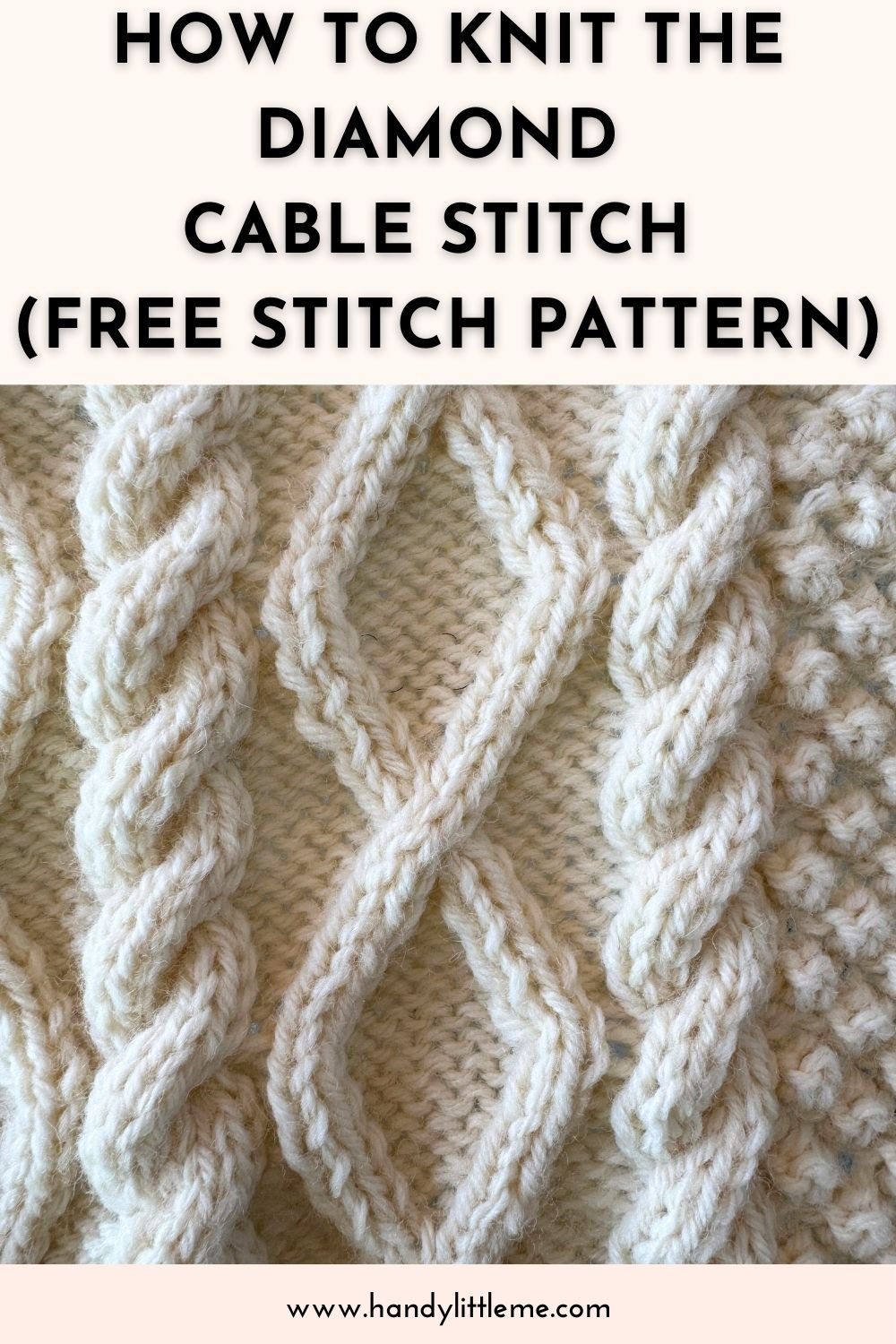
Step-By-Step: How the Diamond Cable Works
1. Cast on & setup
- For a tidy swatch, CO 20 sts: 4 edge sts, 12-st diamond panel, 4 edge sts.
- Work a couple of setup rows in reverse st st (RS purl, WS knit) if you like a border.
2. Crossing stitches form the diamonds
- The crosses (T3F/T3B) “lean” stitches left/right to outline each diamond.
- Midway, a wider cross (C4B/C6B) tightens the center for a crisp, faceted look.
3. Repeat consistently
- The written pattern row-by-row below spans Rows 1–18.
- Repeat Rows 1–18 to stack diamonds vertically.
Tip: Place markers around the 12-st panel so RS/WS stitches on the edges stay relaxed and even (instant hygge knitting vibes).
Pattern Instructions (Row-by-Row)
Panel: 12 sts on a background of reverse st st.
Sample swatch: CO 20 sts (4 edge sts · 12 panel · 4 edge sts).
- Work edge sts in reverse stockinette (on RS: P edges; on WS: K edges).
- The rows listed below describe the 12-st diamond panel; add your edge stitches as noted.
Row 1 (RS): P3, T3B, T3F, P3.
Row 2 (WS): K3, P2, K2, P2, K3.
Row 3: P2, T3B, P2, T3F, P2.
Row 4: K2, P2, K4, P2, K2.
Row 5: P1, T3B, P4, T3F, P1.
Row 6: K1, P2, K6, P2, K1.
Row 7: T3B, P6, T3F.
Row 8: P2, K8, P2.
Row 9: T3F, P6, T3B.
Row 10: K1, P2, K6, P2, K1.
Row 11: P1, T3F, P4, T3B, P1.
Row 12: K2, P2, K4, P2, K2.
Row 13: P2, T3F, P2, T3B, P2.
Row 14: K3, P2, K2, P2, K3.
Row 15: P3, T3F, T3B, P3.
Row 16: K4, P4, K4.
Row 17: P4, C4B, P4.
Row 18: K4, P4, K4.
Repeat Rows 1–18 for the diamond cable pattern.
Use the swatch as a free knitting stitch reference for your ultimate knitting stitch library.
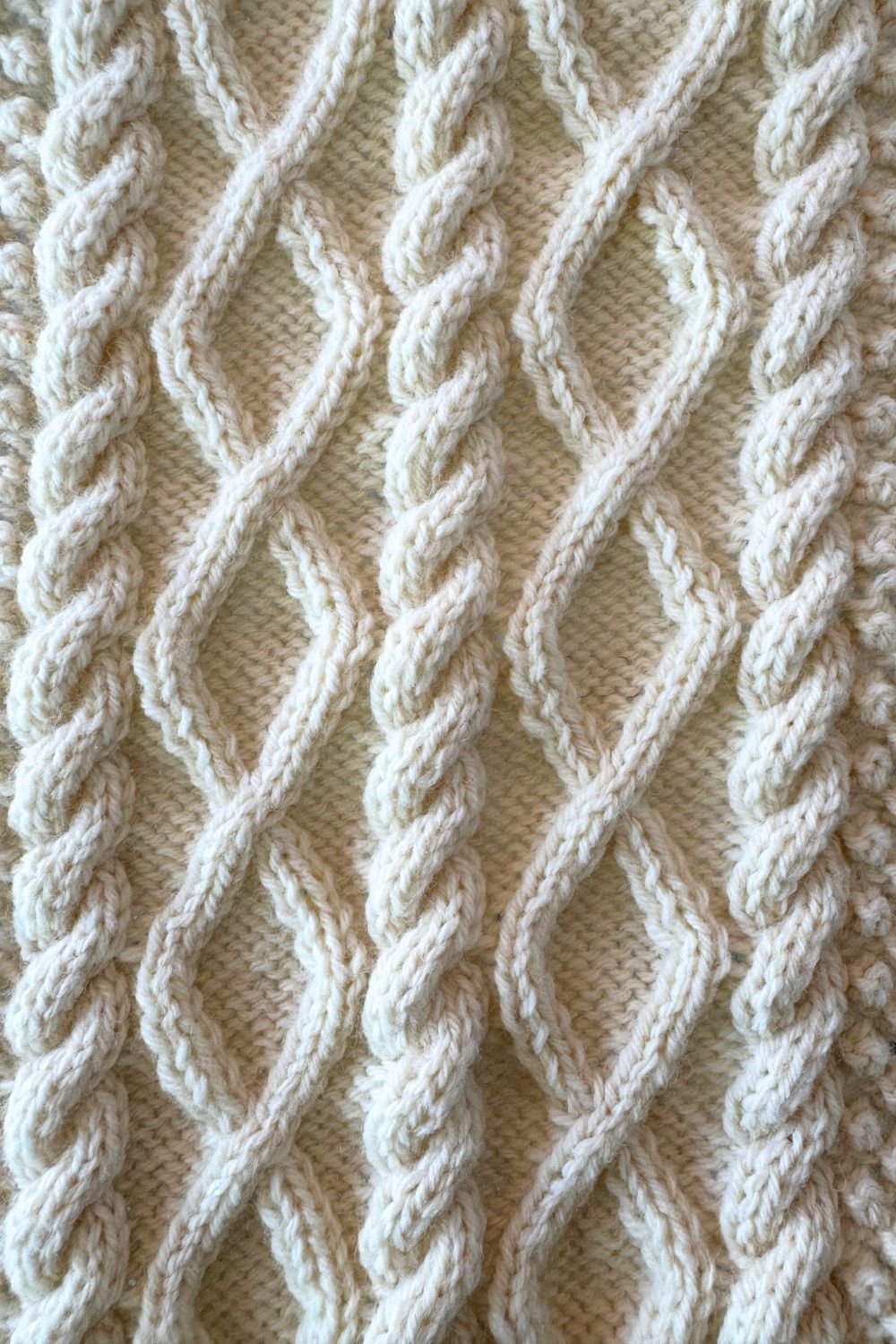
Free Printable
If you prefer to work from a printed pattern or just want a version you can take on the go, I’ve got you covered!
You can print the pattern below to keep it handy while you knit.
Diamond Cable Stitch
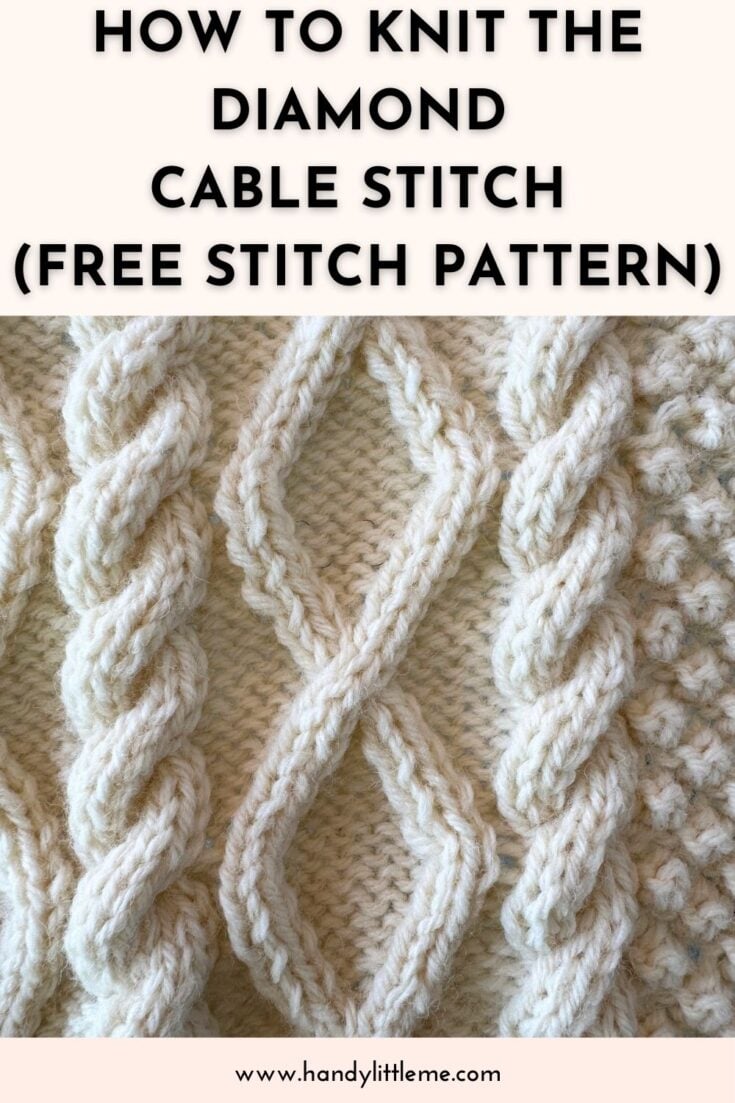
Print-ready Diamond Cable Stitch how-to: a one-page, row-by-row reference. Includes tools, abbreviations, swatch setup, and the 18-row repeat—perfect for intermediate knitters.
Materials
- Yarn: Any smooth yarn with good stitch definition (wool or cotton are great). For practice, try worsted/Aran weight yarn. ~20–30 g (≈ 20–30 meters) is plenty for a swatch.
Tools
- Needles: Size to suit your yarn (needles size per ball band). Many knitters like US 7–9 (4.5–5.5 mm) for worsted/Aran.
- Cable needle (CN): Straight or hook-style.
- Notions: Stitch markers, row counter or notebook, tapestry needle for finishing.
- Optional: Blocking pins/mats or a steamer.
Instructions
Step-By-Step: How the Diamond Cable Works
1. Cast on & setup
- For a tidy swatch, CO 20 sts: 4 edge sts, 12-st diamond panel, 4 edge sts.
- Work a couple of setup rows in reverse st st (RS purl, WS knit) if you like a border.
2. Crossing stitches form the diamonds
- The crosses (T3F/T3B) “lean” stitches left/right to outline each diamond.
- Midway, a wider cross (C4B/C6B) tightens the center for a crisp, faceted look.
3. Repeat consistently
- The written pattern row-by-row below spans Rows 1–18.
- Repeat Rows 1–18 to stack diamonds vertically.
Tip: Place markers around the 12-st panel so RS/WS stitches on the edges stay relaxing and even (instant hygge knitting vibes).
Pattern Instructions (Row-by-Row)
Panel: 12 sts on a background of reverse st st.Sample swatch: CO 20 sts (4 edge sts · 12 panel · 4 edge sts).
- Work edge sts in reverse stockinette (on RS: P edges; on WS: K edges).
- The rows listed below describe the 12-st diamond panel; add your edge stitches as noted.
Row 1 (RS): P3, T3B, T3F, P3.
Row 2 (WS): K3, P2, K2, P2, K3.
Row 3: P2, T3B, P2, T3F, P2.
Row 4: K2, P2, K4, P2, K2.
Row 5: P1, T3B, P4, T3F, P1.
Row 6: K1, P2, K6, P2, K1.
Row 7: T3B, P6, T3F.
Row 8: P2, K8, P2.
Row 9: T3F, P6, T3B.
Row 10: K1, P2, K6, P2, K1.
Row 11: P1, T3F, P4, T3B, P1.
Row 12: K2, P2, K4, P2, K2.
Row 13: P2, T3F, P2, T3B, P2.
Row 14: K3, P2, K2, P2, K3.
Row 15: P3, T3F, T3B, P3.
Row 16: K4, P4, K4.
Row 17: P4, C4B, P4.
Row 18: K4, P4, K4.
Repeat Rows 1–18 for the diamond cable pattern.
Use the swatch as a free knitting stitch reference for your ultimate knitting stitch library.
Notes
Abbreviations
- CO – cast on
- K – knit
- P – purl
- RS - right side
- WS – wrong side
- st(s) – stitch(es)
- cont – continue
Cable abbreviations
- C4B – Slip 2 sts to CN and hold at back; K2, then K2 from CN.
- T3B – Slip next st to CN and hold at back; K2 from left hand needle, then P1 from CN.
- T3F – Slip next 2 sts to CN and hold at front; P1 from left hand needle, then K2 from CN.
Variations & Project Ideas
- Variations: Try a double diamonds cable knitting stitch, twisted diamonds (use ktbl inside), honeycomb fills, or lace-filled/open diamonds.
- Great projects: Cardigans, scarves, headbands, hats, cushions, and full-sized cozy throw/cable blanket.
- Decor: Add diamond panels to home decor: runners, pillow fronts—mix with different cable stitches for a sampler look.
Blocking Guide (Do You Need to Block Cables?)
Yes, gentle blocking evens tension and sharpens the cable lines.
- Wool: Steam lightly from above; don’t press the cable ridges.
- Plant fibers: Wet block; pat diamonds to shape.
- Acrylic: Hover steam only; avoid direct pressure to keep definition.
Always swatch-test first.
Related Post: Blocking Knits – How To Block Knitting Guide
FAQs & Tips
Is this an Aran stitch pattern?
Yes. Diamonds are a traditional Aran motif (often linked with prosperity).
They look fantastic alone or flanked by ropes/plaits.
Chart or written?
You can follow the pattern instructions above (written) or convert to a chart if you prefer to “see” the cable pattern.
Related Post: How To Read A Knitting Chart
How do I keep edges neat?
Work the edge stitches in consistent reverse st st and don’t tug on the yarn after crossings.
What if I don’t have a cable needle?
You can carefully drop-and-rearrange, but a small cable needle is friendlier—especially while learning.
How big is a repeat in cm?
It depends on yarn/needles/gauge.
Measure your blocked swatch and note the width/height in cm to plan repeats.
Troubleshooting at a glance:
- Laddering beside cables → tighten the first stitch after each cross.
- Uneven diamonds → check you’re working T3B/T3F with stitches held to the correct side (back/front).
- Lost track on a WS row → count purls between raised columns before the next cross.
Want to Learn More?
- Knitting Lessons – Cast on, bind off, read a chart, and more (perfect for fellow knitters leveling up).
- Different Cable Stitches & Patterns – Explore braids, ropes, honeycomb, and plaits.
- Share your swatch on Facebook here – Handylittleme Facebook group — join the conversation in the comments section!
More Cable Stitches And Patterns
- Men’s Aran Sweater Knitting Pattern
- Aran Dog Sweater Knitting Pattern
- 8 Cable Stitch Knitting Patterns
- 31+ Free Cable Stitch Patterns To Knit (+ Tutorials)
- Celtic Cable Dishcloth Knitting Pattern (+ Free PDF)
- Highlander Cable Knit Hat Pattern
- Chunky Cable Knit Blanket Pattern (Free Easy Throw)
- Cable Hat Free Knitting Pattern | The Bordeaux
- How To Knit A Simple Cable Pattern (+ Video Tutorial)