
PSSO Knitting: How To Pass Slipped Stitch Over
THIS ARTICLE CONTAINS AFFILIATE LINKS THAT SUPPORT HANDY LITTLE ME CONTENT AND FREE PATTERNS.Learn PSSO knitting, also known as pass slipped stitch over, with this easy beginner-friendly tutorial.
PSSO is a common knitting abbreviation used in patterns when you need to pass a slipped stitch over another stitch.
It is often used in decreases, lace knitting, shaping, buttonholes, and decorative stitch patterns.
In this tutorial, you’ll learn what PSSO means in knitting, how to work the technique step by step, how it is used in common decreases, and how to knit S1 K2tog PSSO.

Save this article
Enter your email address and we'll send it to your inbox.
By entering your email, you agree to receive patterns, tutorials, and updates from Handy Little Me. Unsubscribe at any time.
Quick Answer: What Does PSSO Mean In Knitting?
PSSO means pass slipped stitch over.
To work a PSSO, you slip a stitch from the left-hand needle to the right-hand needle, work the next stitch or stitches as instructed, then lift the slipped stitch over the worked stitch and off the needle.
PSSO is often used as part of a decrease because it reduces the number of stitches on your needle.
You may see it written in patterns as sl 1, k1, psso, sl 1, k2tog, psso, or simply PSSO.
PSSO At A Glance
| Detail | Information |
|---|---|
| Abbreviation | PSSO |
| Meaning | Pass slipped stitch over |
| Type of technique | Often used as a decrease |
| Skill level | Beginner to intermediate |
| Commonly used in | Lace, shaping, buttonholes, stitch patterns, and decreases |
| Related techniques | SSK, K2tog, YO, SKP, S1 K2tog PSSO |
| Stitch count | Depends on the full instruction |
Before You Start
Before learning PSSO, it helps if you already know how to:
- Knit
- Purl
- Slip a stitch
- Knit two stitches together
- Recognize knit and purl stitches
- Read simple knitting abbreviations
You can practice PSSO on a small swatch before using it in a pattern.
This is especially helpful because PSSO is often used as part of longer instructions rather than as a stand-alone stitch.
What Is PSSO Knitting?
PSSO knitting is a technique where a slipped stitch is passed over another stitch and off the needle.
It is not usually worked alone. Instead, it appears as part of a larger instruction.
For example, you might see:
- Sl 1, K1, PSSO
- Sl 1, K2tog, PSSO
- YO, K2tog, PSSO
- S1 K2tog PSSO
The important part to remember is that the slipped stitch is lifted over the worked stitch and dropped off the right-hand needle.
This creates a decrease or decorative effect, depending on the pattern.
Is PSSO A Decrease?
PSSO is often used as part of a decrease.
When you pass the slipped stitch over another stitch and off the needle, you remove one stitch from your stitch count.
However, the exact number of stitches decreased depends on the full instruction.
For example:
| Instruction | What It Does |
|---|---|
| Sl 1, K1, PSSO | Decreases 1 stitch |
| Sl 1, K2tog, PSSO | Decreases 2 stitches |
| YO, K2tog, PSSO | May balance an increase and decrease, depending on the pattern |
This is why it’s important to read the full pattern instruction, not just the abbreviation PSSO on its own.
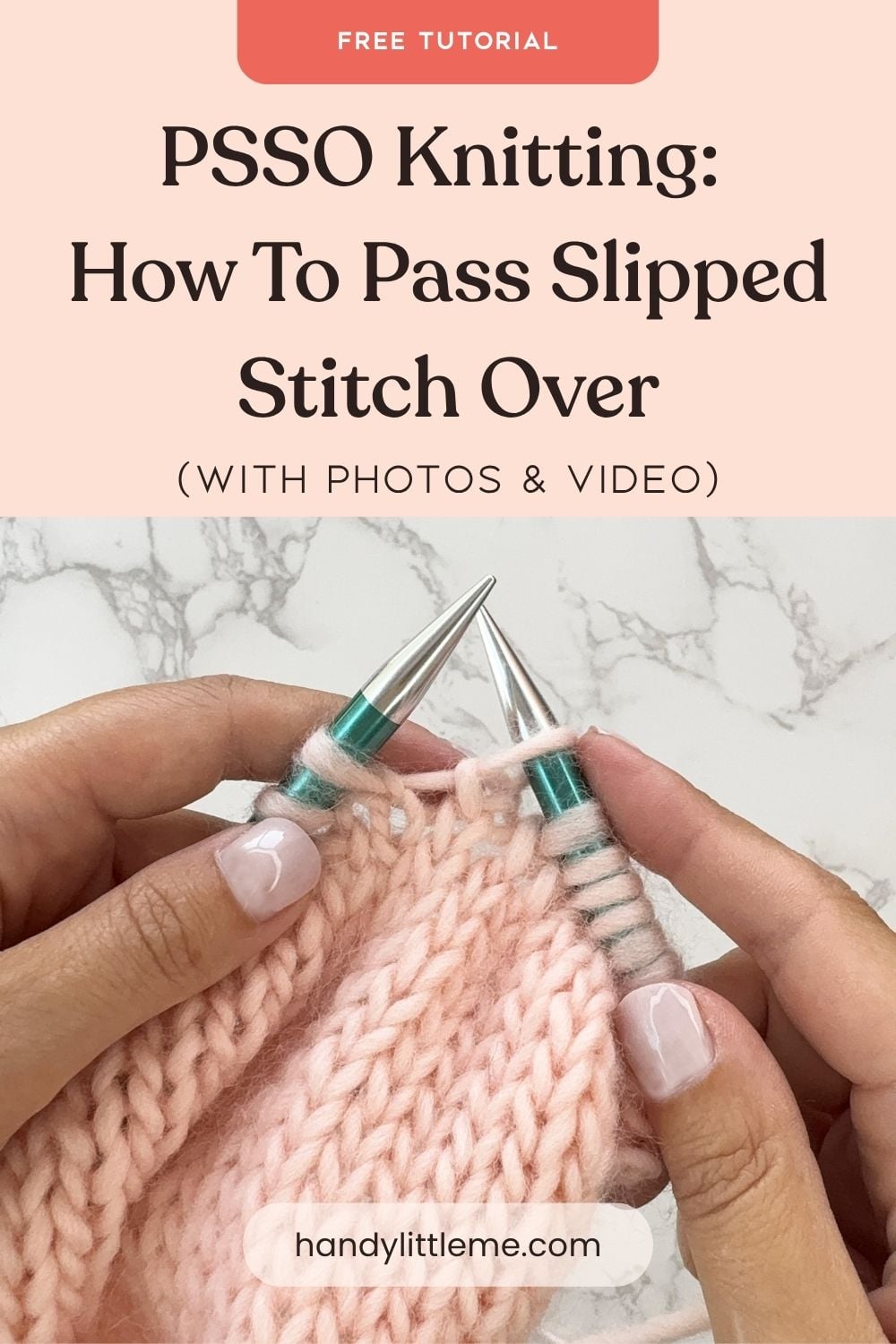
How To PSSO In Knitting
To work a basic PSSO, follow these steps.
Step 1 – Slip one stitch
Slip the next stitch from the left-hand needle to the right-hand needle.
In many patterns, this stitch is slipped knitwise unless the pattern tells you otherwise.
Step 2 – Work the next stitch
Knit the next stitch, or work the next instruction given in your pattern.
For a basic PSSO decrease, this is often written as K1.
Step 3 – Insert the left needle into the slipped stitch
Use the tip of the left-hand needle to lift the slipped stitch on the right-hand needle.
The slipped stitch should be sitting just behind or beside the stitch you have just worked.
Step 4 – Pass the slipped stitch over
Lift the slipped stitch over the worked stitch and over the tip of the right-hand needle.
Let the slipped stitch drop off the needle.
Step 5 – Check your stitch count
You should now have decreased by one stitch if you worked a basic sl 1, k1, psso.
If your pattern uses PSSO as part of a different instruction, check the stitch count for that specific decrease.
Video Tutorial – PSSO
Watch the video tutorial below to see how to work PSSO step by step.
How To Knit Sl 1, K1, PSSO
A common PSSO instruction is sl 1, k1, psso.
This means:
- Slip 1 stitch.
- Knit 1 stitch.
- Pass the slipped stitch over the knitted stitch and off the needle.
This decreases one stitch.
It is sometimes called SKP, which stands for slip, knit, pass.
You may see this type of decrease used in lace knitting, shaping, decorative stitch patterns, and older knitting patterns.
How To Knit S1 K2tog PSSO
Another common instruction is S1 K2tog PSSO.
This means:
- Slip 1 stitch.
- Knit the next 2 stitches together.
- Pass the slipped stitch over the K2tog stitch and off the needle.
This is a double decrease because it turns three stitches into one stitch.
You may also see it written as:
- Sl 1, K2tog, PSSO
- S1, K2tog, PSSO
- Slip 1, knit 2 together, pass slipped stitch over
This decrease is often used in lace knitting and decorative stitch patterns.
Video Tutorial – Sl 1, K2tog, PSSO
Watch the video tutorial below to see how to work Sl 1, K2tog, PSSO step by step.
This is a double decrease because it turns three stitches into one stitch.
Is S1 K2tog PSSO A Double Decrease?
Yes, S1 K2tog PSSO is a double decrease.
It decreases two stitches because three stitches become one stitch.
First, K2tog decreases one stitch by knitting two stitches together.
Then PSSO decreases another stitch by passing the slipped stitch over and off the needle.
This type of double decrease can create a neat shaped decrease in lace, leaves, chevrons, and decorative motifs.
PSSO Vs SSK
PSSO and SSK are both decrease techniques, but they are worked differently.
SSK stands for slip slip knit.
To work SSK, you slip two stitches knitwise, then knit them together through the back loops.
PSSO means pass slipped stitch over.
To work PSSO, you slip a stitch, work the next stitch or stitches, then pass the slipped stitch over.
| Technique | Meaning | Common Use |
|---|---|---|
| PSSO | Pass slipped stitch over | Decreases, lace, shaping, decorative patterns |
| SSK | Slip slip knit | Left-leaning decrease |
| K2tog | Knit two together | Right-leaning decrease |
Some patterns use PSSO where newer patterns might use SSK, but they are not exactly the same technique.
Always follow the abbreviation used in your pattern.
PSSO Vs K2tog
PSSO and K2tog are both used in decreases, but they are not the same.
K2tog means knit two stitches together.
PSSO means pass a slipped stitch over another stitch.
K2tog usually creates a right-leaning decrease.
PSSO can create a different look depending on how the slipped stitch is worked and what comes before it.
You may often see PSSO and K2tog used together, especially in the instruction S1 K2tog PSSO.
PSSO And Yarn Over
PSSO is often used with yarn over in lace knitting.
A yarn over adds a stitch and creates an eyelet.
PSSO decreases stitches and helps shape the lace.
When used together, they can create decorative holes, slants, leaves, diamonds, and openwork patterns.
For example, a pattern may use a yarn over to create a hole, then use PSSO or K2tog to balance the stitch count.
Common PSSO Mistakes
Forgetting to slip the stitch first
You need a slipped stitch before you can pass it over.
If you forget to slip the stitch, you will not be able to complete the PSSO correctly.
Passing the wrong stitch over
Make sure you pass the slipped stitch over, not the stitch you just worked.
The slipped stitch is the one that was moved from the left-hand needle to the right-hand needle before working the next stitch.
Dropping the worked stitch
When lifting the slipped stitch over, be careful not to pull the worked stitch off the needle by mistake.
Move slowly until the motion feels comfortable.
Slipping the stitch the wrong way
Many PSSO instructions use a stitch slipped knitwise, but some patterns may specify otherwise.
If the pattern tells you to slip purlwise, follow the pattern.
The way you slip the stitch can change how the decrease looks.
Losing track of the stitch count
PSSO often changes your stitch count.
Check whether the instruction is a single decrease, double decrease, or part of a balanced lace pattern with yarn overs.
Tips For Working PSSO
Keep your tension relaxed when slipping the stitch.
If the slipped stitch is too tight, it may be difficult to pass it over the worked stitch.
Use the tip of the left-hand needle to lift the slipped stitch gently.
Do not pull too hard when passing the stitch over, as this can distort the fabric.
Practice on a small swatch before using PSSO in lace or shaping.
Read the whole instruction carefully, especially if PSSO appears with K2tog, yarn over, or other decreases.
Which Patterns Use PSSO?
PSSO is used in many knitting patterns, especially patterns with shaping or lace.
You may see PSSO in:
- Lace shawls
- Scarves
- Eyelet patterns
- Leaf stitch patterns
- Sweaters
- Cardigans
- Sleeves
- Socks
- Hats
- Baby blankets
- Decorative stitch patterns
- Buttonholes
- Older knitting patterns
It is a useful abbreviation to learn because it appears in many beginner, intermediate, and vintage knitting patterns.
How To Practice PSSO
Try this simple practice swatch.
Cast on 15 stitches.
- Row 1: Knit all stitches.
- Row 2: K5, sl 1, k1, psso, knit to end.
- Row 3: Knit all stitches.
Repeat these rows a few times to practice a basic PSSO decrease.
To practice S1 K2tog PSSO, try this:
Cast on 15 stitches.
- Row 1: Knit all stitches.
- Row 2: K5, sl 1, k2tog, psso, knit to end.
- Row 3: Knit all stitches.
This will help you see how the double decrease looks in your fabric.
PSSO Knitting FAQs
What does PSSO mean in knitting?
PSSO means pass slipped stitch over.
It tells you to lift a slipped stitch over another stitch and off the needle.
How do you PSSO in knitting?
To PSSO, slip a stitch, work the next stitch or stitches as instructed, then lift the slipped stitch over the worked stitch and off the needle.
Is PSSO a decrease?
PSSO is often used as a decrease because passing the slipped stitch over removes a stitch from the needle.
The total decrease depends on the full instruction.
What does sl 1, k1, psso mean?
Sl 1, k1, psso means slip one stitch, knit one stitch, then pass the slipped stitch over the knitted stitch.
This decreases one stitch.
What does S1 K2tog PSSO mean?
S1 K2tog PSSO means slip one stitch, knit the next two stitches together, then pass the slipped stitch over the K2tog stitch.
This is a double decrease.
Is PSSO the same as SSK?
No, PSSO and SSK are different decrease techniques.
SSK means slip slip knit, while PSSO means pass slipped stitch over.
Do you slip knitwise for PSSO?
Many PSSO instructions use a stitch slipped knitwise, but you should follow your pattern.
If the pattern says to slip purlwise, slip the stitch purlwise.
What is SKP in knitting?
SKP means slip, knit, pass.
It is another way of writing sl 1, k1, psso.
Can beginners learn PSSO?
Yes, beginners can learn PSSO once they know how to knit, slip a stitch, and pass a stitch over another stitch.
Practice slowly on a small swatch first.
More Knitting Increase And Decrease Tutorials
If you found this PSSO knitting tutorial helpful, you may also like these knitting guides:
- How To Increase Stitches In Knitting
- KFB Knitting: How To Knit Front And Back
- M1L and M1R Knitting Increases: Make One Left and Right
- How To Yarn Over In Knitting
- How To Knit Lifted Increases: RLI and LLI
- How To Decrease Knitting
- How To Knit 2 Together (K2tog)
- SSK Knitting Tutorial: How To Slip Slip Knit
- P2tog Knitting: How To Purl Two Together
- SSP Knitting: How To Slip Slip Purl
- How To Knit CDD: Centered Double Decrease
- Knitting Abbreviations
- How To Read Knitting Patterns
PSSO is a useful knitting technique that appears in many patterns, especially lace, shaping, and decorative stitch patterns.
Once you understand how to pass a slipped stitch over, you’ll find it much easier to follow abbreviations like sl 1, k1, psso, and S1 K2tog PSSO.