
How To Hold A Crochet Hook (Tutorials + Tips)
THIS ARTICLE CONTAINS AFFILIATE LINKS THAT SUPPORT HANDY LITTLE ME CONTENT AND FREE PATTERNS.Crochet is easier and more comfortable when you hold your hook the right way.
In this tutorial, you’ll learn the different ways to hold a crochet hook, tips for comfort, and answers to common questions (including Tunisian and Afghan crochet).
One question I’m often asked is: How do you hold a crochet hook?
Which is a great question — and one that leads to looking at different types of crochet hooks.

Save this article
Enter your email address and we'll send it to your inbox.
By entering your email, you agree to receive patterns, tutorials, and updates from Handy Little Me. Unsubscribe at any time.
Before You Get Started
Here are a few things to know before you begin:
- Everyone holds a crochet hook differently — there’s no one “right” way.
- Comfort matters most. Find a grip that suits your hands and lets you crochet longer.
- Ergonomic hooks can make a big difference if you struggle with grip or hand pain.
- Yarn tension and hand position work together with your hook hold.
Choosing Your Crochet Hook
Here are my top recommendations for crochet hooks for beginners:
Addi crochet hooks
The Addi crochet hooks are one of my favorite brands, mainly because I find the handles easy to grip and comfortable to work with.
I have some ergonomic crochet hooks with colored handles, and they are really easy to use.
They have a soft-grip handle and a smooth hook, which is great for working with.
Knit Pro crochet hooks
The Knitters Pride sets come in a range of materials, from bamboo, multi-colored wood, and plastic.
They also have sets with ergonomic handles, which are good for comfort.
Some of the wooden hooks are great for new crocheters, as they are smooth to work with.

Crochet hook sets
There are many crochet hook sets out there with a range of hook sizes.
These are pretty good for beginners, so you can try out different sizes.
From Susan Bates crochet hooks, Pony crochet hooks, and Lykke crochet hooks to other sets featuring ergonomic hooks, there are many to choose from.
The Addi hooks are lightweight and easy to hold.
You can also treat yourself to a crochet hook case or bag and keep everything together.
You can also treat yourself to a crochet hook case or bag and keep everything together.
Should I buy a crochet hook set?
If you are thinking of buying a set of crochet hooks with various crochet hook sizes, it would be worth it for you (as a beginner) if they are quite inexpensive and have hundreds of good reviews.
But it might be better to try out a couple of hooks before you splurge on a set, as some sets can be quite expensive.
I bought a fairly cheap set of different crochet hooks for around $17, and they are great, have good grip handles, and are easy to work with.
But I also bought the Prym white/purple grip hooks, which were more expensive, and I do prefer using them.
So I guess you have to try these things out and see which ones best fit your hands and allow you to find your own rhythm.
Related post: Crochet Hook Sizes Chart (A Free Conversion Guide)

Step-by-Step: How to Hold a Crochet Hook
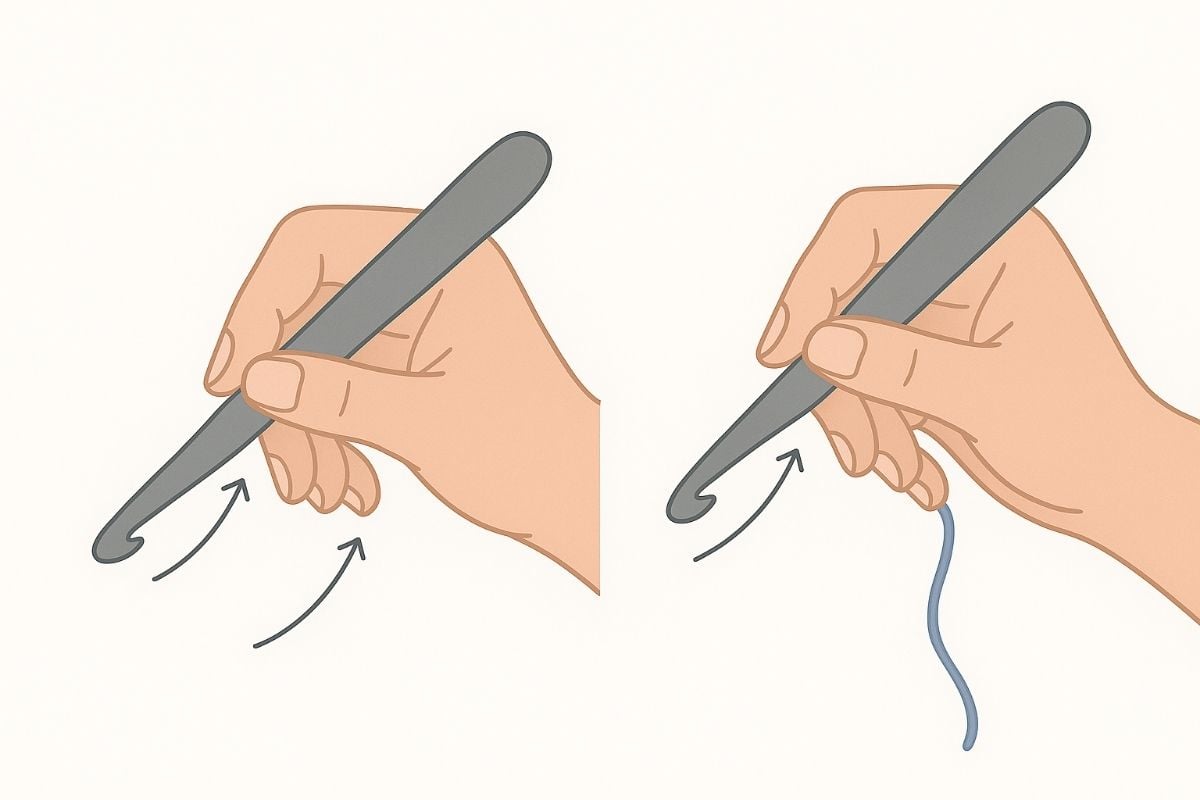
There are a few variations in how people hold their hook;
- Like a pencil or pen
- Like a knife
I think I fall into the first way of holding the hook, a bit like a pen or a pencil.
This seems to work for me, but everyone has their own way of doing it, which makes them feel comfortable when working.
Ultimately, the best way is the most comfortable way for you.
We will explore some options below on how to hold a traditional crochet hook as opposed to a Tunisian crochet hook or an afghan crochet hook.
We will explore some options below on how to hold a traditional crochet hook as opposed to a Tunisian crochet hook or an Afghan crochet hook.

1. Like a Pencil or Pen
Right-Handed
When you hold the crochet hook, you hold it as if you were holding a pencil (pencil grip) or pen and are about to write, with the hook in between your middle finger and pointer finger.
Hold the hook from above and then work into your stitches downwards.
If you want to try this out, hold your hook pen style – with your thumb and index finger.
Hold the crochet work with your right hand, and use your left hand to help you work the yarn and keep the tension.
Left-Handed
If you are left-handed, the method is practically the same but just reversed.
Depending on how you like to hold your pen, find a way of working the hook and yarn that is comfortable for you.

2. Like a Knife
Right-Handed
When you hold your hook like a knife (knife hold), you place your forefinger from your right hand on top of the hook for greater control (an overhand grip).
This allows the hook to be worked from below and move up into the stitches.
To practice this method, hold your hook in your right hand with your index finger on top of the hook, guiding it in and out of the stitches.
Hold the work with your left hand, and use your left hand to help you work the yarn and keep the tension.
Left-Handed
Just as with the right-handed dinner knife grip, you can reverse the grip of the hook.
This may be an easier way to hold your hook, so it is worth trying out this method.
FAQs & Extra Tips
1. How to hold a Tunisian crochet hook?
Tunisian crochet hooks are usually longer than traditional hooks (sometimes with a stopper or flexible cable), and they hold many stitches at once.
The good news is, you can hold a Tunisian crochet hook in much the same way as a regular one. The two most common methods are:
- Pencil Hold: the hook, like a pencil or pen, between your thumb and forefinger, while the handle of the hook rests lightly on your palm. This pencil method gives precision and works well for small projects.
- Knife Method: Hold the hook as you would hold a knife, with your thumb on one side and your fingers on the other. This gives more control and is comfortable for longer rows.
The main difference is that in Tunisian crochet, the fabric stays on the hook during the forward pass.
You’ll often rest the growing fabric across your lap or let it slide down onto the stopper/cable while you work near the hook tip.
As with regular crochet, there is no “wrong” way—just find a grip that feels natural and keeps your hands relaxed.
2. Do you hold an Afghan crochet hook differently from a regular crochet hook?
Not really. You can use the same two common grips, the pencil grip or the knife grip.
The main difference is that you’ll often support the fabric on your lap or let it slide down the hook/cable because Afghan crochet projects hold more stitches at a time.
3. Is it better to hold your crochet hook like a pencil or a knife?
Most crocheters naturally prefer one grip over the other, and some even switch between the two depending on the project.
The key is to keep your hands relaxed and choose the grip that helps you crochet comfortably for longer periods of time.
4. How to hold a crochet hook with arthritis?
Crocheting with arthritis can be challenging, but the right hook and grip can make a big difference.
The goal is to reduce strain on your fingers and wrists while keeping your stitches comfortable and even.
- Use ergonomic crochet hooks
Choose hooks with soft, cushioned, or thicker handles
An ergonomic crochet hook is easier to grip and reduces the need to pinch tightly.
- Try different grips
Some crocheters with arthritis find the knife grip (overhand) easier, while others prefer the pencil grip.
Experiment to see which puts less strain on your joints.
- Support your hands
Rest your project on your lap or a table to reduce the weight in your hands.
Take frequent breaks and gently stretch your fingers and wrists.
- Use lightweight materials
Smooth yarn and larger hooks can make crocheting easier, as you won’t need to grip as tightly.
- Add comfort aids
Foam or rubber grips that slide onto crochet hooks can give extra padding.
Some crocheters even use pencil grips or DIY solutions to make handles thicker and easier to hold.
5. How to avoid pain while crocheting?
Crocheting should be relaxing, but long sessions or poor habits can sometimes cause hand, wrist, or shoulder pain.
The good news is that a few simple adjustments can help you crochet more comfortably and avoid strain.
- Choose ergonomic tools
For comfortable crocheting, use crochet hooks with soft-grip or ergonomic handles to reduce the amount of pinching and pressure on your fingers.
Lightweight yarns and hooks can also make long projects easier on your hands.
- Check your posture
Sit with your back supported and shoulders relaxed.
Keep your wrists straight and avoid hunching forward over your work.
Place a pillow or rolled towel under your arms if you need extra support.
- Practice healthy yarn tension
Hold the yarn loosely so it flows smoothly through your fingers.
If your stitches are too tight, your hands will have to work harder, which can cause unnecessary strain.
- Take regular breaks
Every 20–30 minutes, put down your work and gently stretch your hands, wrists, and shoulders.
Flexing your fingers and rotating your wrists can release tension.
- Switch up your grip
Try both the pencil grip and knife grip for your hook to see which feels less tiring.
Some crocheters even switch between grips during a project to prevent fatigue.
The key to avoiding pain while crocheting is listening to your body.
If you feel discomfort, take a break and adjust your tools, posture, or tension until the discomfort subsides.
6. Can you hold the crochet hook in your non-dominant hand?
Traditionally, crocheters hold the hook in their dominant hand and use the non-dominant hand to guide the yarn and hold the fabric.
For example, right-handed crocheters hold the hook in the right hand, while left-handed crocheters hold it in the left.
That said, you can try holding the hook in your non-dominant hand, but it may feel awkward and slower, especially as a beginner.
Most patterns, tutorials, and stitch diagrams are also written assuming the hook is in the dominant hand, which can make learning harder if you switch.
If you’re left-handed and following a right-handed tutorial, the easiest solution is usually to mirror the instructions rather than trying to crochet with your non-dominant hand.
7. How to hold yarn for good tension?
Good yarn tension is the key to making your crochet stitches even and consistent.
There are several ways to hold the yarn, and beginners may need to experiment to find what feels natural.
- Wrap around the fingers
Loop the yarn once around your little finger (pinky).
Guide the yarn over your ring and middle finger.
Let it rest over your index finger to feed into the hook.
This method gives you steady tension and is popular with many crocheters.
- Over the index finger
Simply drape the yarn over your index finger.
Use slight movements of your finger to loosen or tighten as you work.
This is an easy method for beginners who don’t want too many wraps.
- Around the pinky finger only
Wrap the yarn around your pinky once or twice, then lead it up to your hook.
This gives more control if your yarn tends to slip or feel too loose.
The goal is to let the yarn flow smoothly without too much pulling.
If your stitches look tight and stiff, loosen your grip. If they look too loose or uneven, try adding another wrap around a finger to increase control.
Tip: Practice with smooth, medium-weight yarn (like worsted weight yarn – cotton or acrylic) until you find a method that gives you consistent tension.
Making swatches or small dishcloths with basic stitches is a great way for a little practice.
Find a crochet project here – 37 Easy Crochet Dishcloth Patterns (+ Free Beginner Pattern)
8. Is there a wrong way to hold yarn when crocheting?
No, there isn’t a single “wrong” way to hold yarn.
The most important thing is that your method feels comfortable and gives you consistent tension.
Every crocheter develops their own style over time, and what works for one person might not feel natural for another.
That said, here are a few signs your yarn hold might need adjusting:
- Your stitches are too tight and difficult to work into.
- Your stitches are too loose and look uneven.
- Your hands feel sore or cramped after only a short time crocheting.
If any of these happen, try experimenting with different ways to wrap the yarn around your fingers, or switch to an ergonomic hook to reduce strain.
The “right” way to hold yarn is the one that lets you crochet comfortably, keeps your stitches even, and allows the yarn to flow smoothly through your fingers.
Crochet For Beginners
Are you new to the wonderful world of crochet?
Learn the basics or refresh your skills with these step by step crochet tutorials.