How To Measure A Dog For A Knitted Sweater
THIS ARTICLE CONTAINS AFFILIATE LINKS THAT SUPPORT HANDY LITTLE ME CONTENT AND FREE PATTERNS.Learning how to measure a dog for a knitted sweater is the best way to get a cozy, comfortable, and safe fit.
Dog clothes are not sized like human clothing, and every pup has a different body shape, so taking your dog’s measurements before you start is an essential process.
Whether you are making a dog sweater, dog coat, or another handmade pet accessory, the right measurements will help you choose the correct size from the pattern size chart.
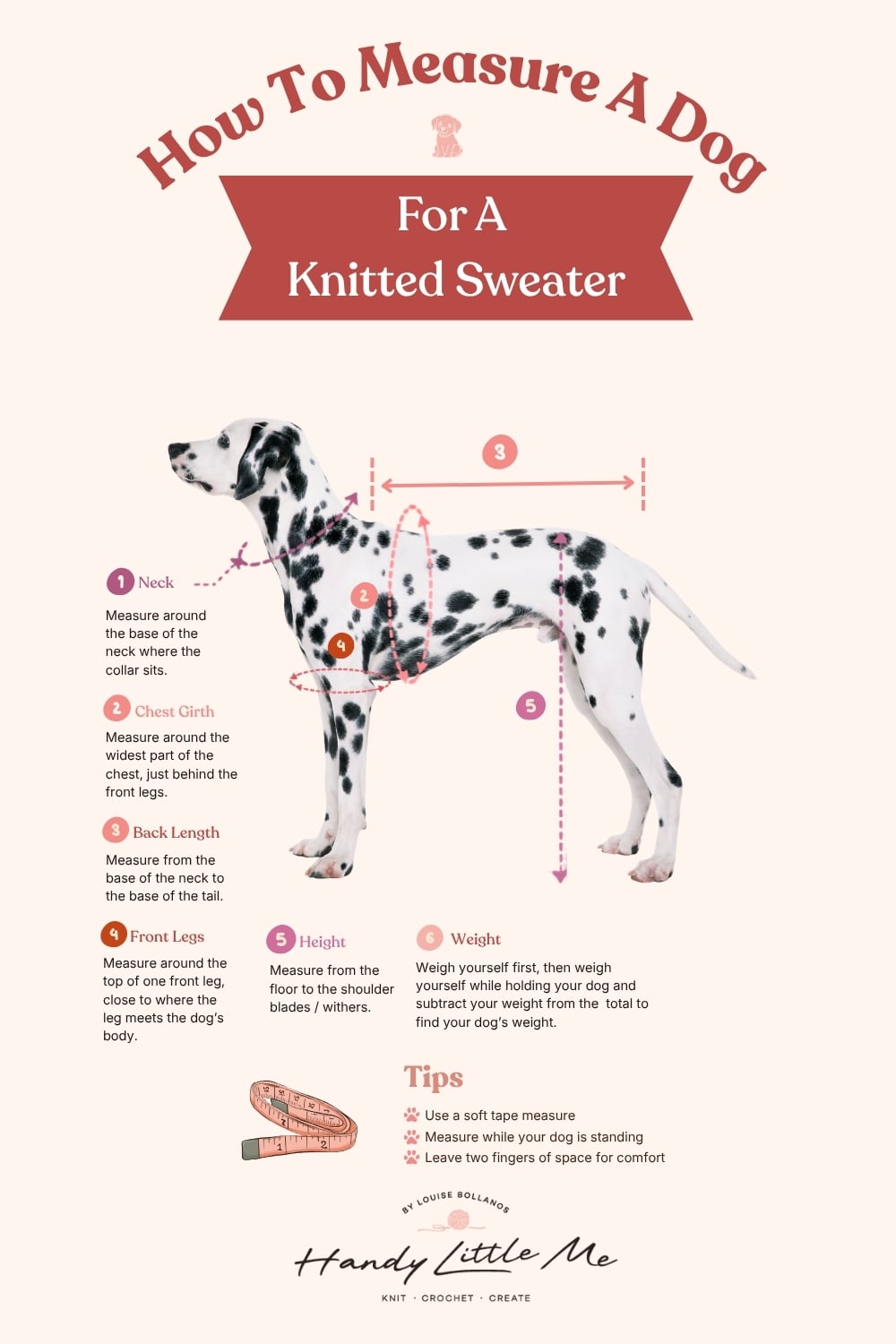
This simple guide will show you the key measurements you need, including the neck measurement, chest girth, back length, and dog’s height.
Save this article
Enter your email address and we'll send it to your inbox.
By entering your email, you agree to receive patterns, tutorials, and updates from Handy Little Me. Unsubscribe at any time.
Why Measuring Your Dog Matters
A knitted dog sweater should keep your dog warm without causing great discomfort.
A poor fit can make it hard for your dog to walk, sit, lie down, or move their front legs freely.
If the sweater is too tight, it can pull around the dog’s neck, chest, or legs.
If it is too loose, it may slip, twist, or get caught while your dog is moving.
The goal is to get the right fit with enough room for freedom of movement.
What You Need To Measure Your Dog
Before you begin, gather a few simple tools.
- A soft tape measure or flexible measuring tape
- A piece of string if you do not have a tape measure
- A ruler if you are using string
- A notebook or your phone to write down your dog’s measurements
- A few treats to help your pup stay still
- The best way to measure your dog is while they are standing in a natural standing position on a flat surface.
- Try not to measure while your dog is sitting, lying down, or curled up, as this can change the measurements.
The Key Measurements For A Dog Sweater
For knitted dog sweater patterns, the most important measurements are:
- Neck measurement
- Chest girth
- Back length
- Dog’s height, if needed
- Weight, if the size chart includes it
Different sizes in a pattern are usually based on chest measurement, back length, and sometimes the dog’s weight.
However, the chest girth is often the most important measurement for a sweater because it tells you how wide the garment needs to be around the dog’s body.
How To Measure A Dog
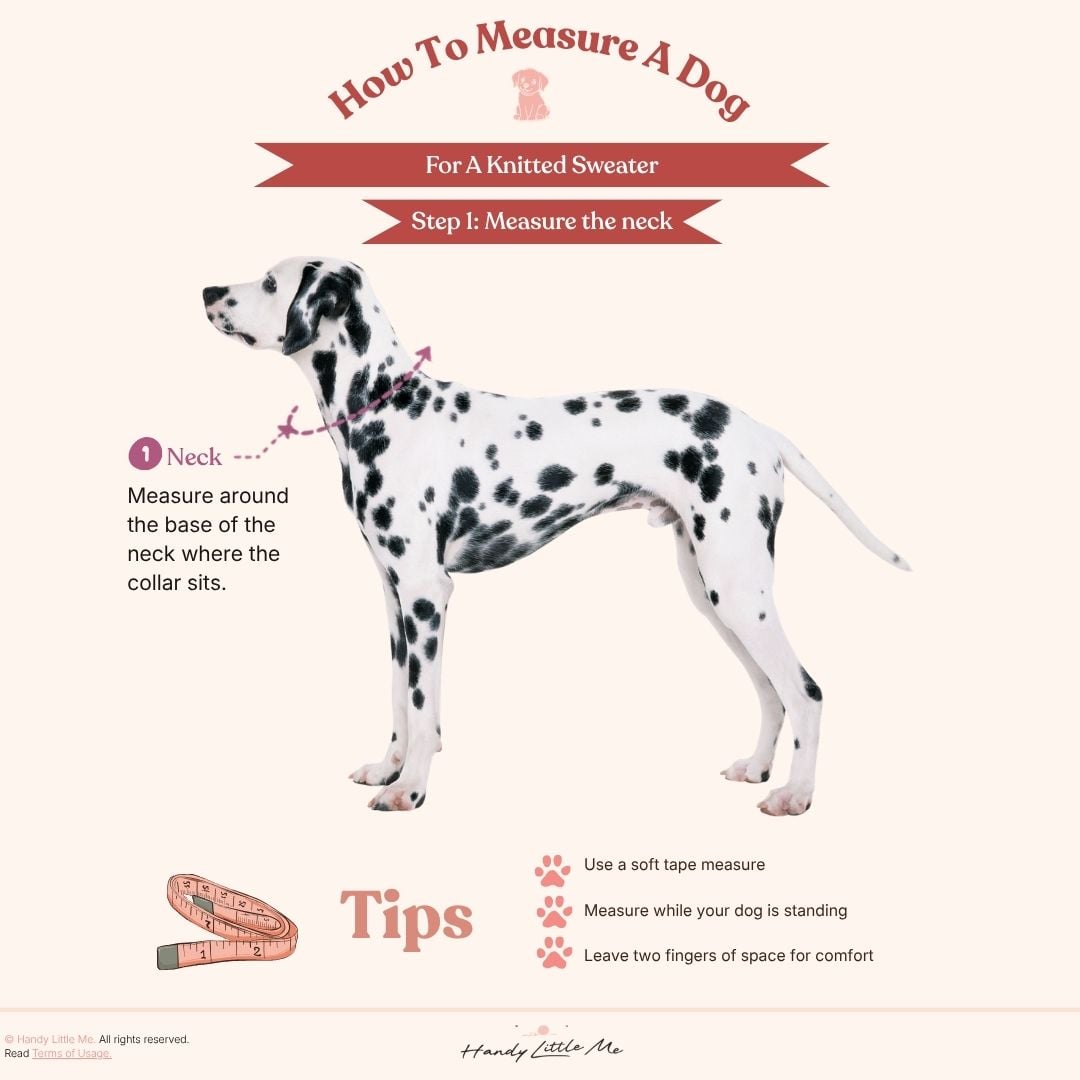
Step 1: Measure The Dog’s Neck
To take the neck measurement, wrap the soft tape measure around the base of the neck.
This is the area where a dog collar would normally sit, not too high under the chin and not too low on the shoulders.
Measure around the dog’s neck circumference and make sure the tape is snug but not tight.
The two-finger rule: you should be able to fit two fingers of space between the tape measure and your dog’s neck.
This gives enough room for comfort, especially if the sweater has a ribbed neck or collar.
Step 2: Measure The Chest Girth
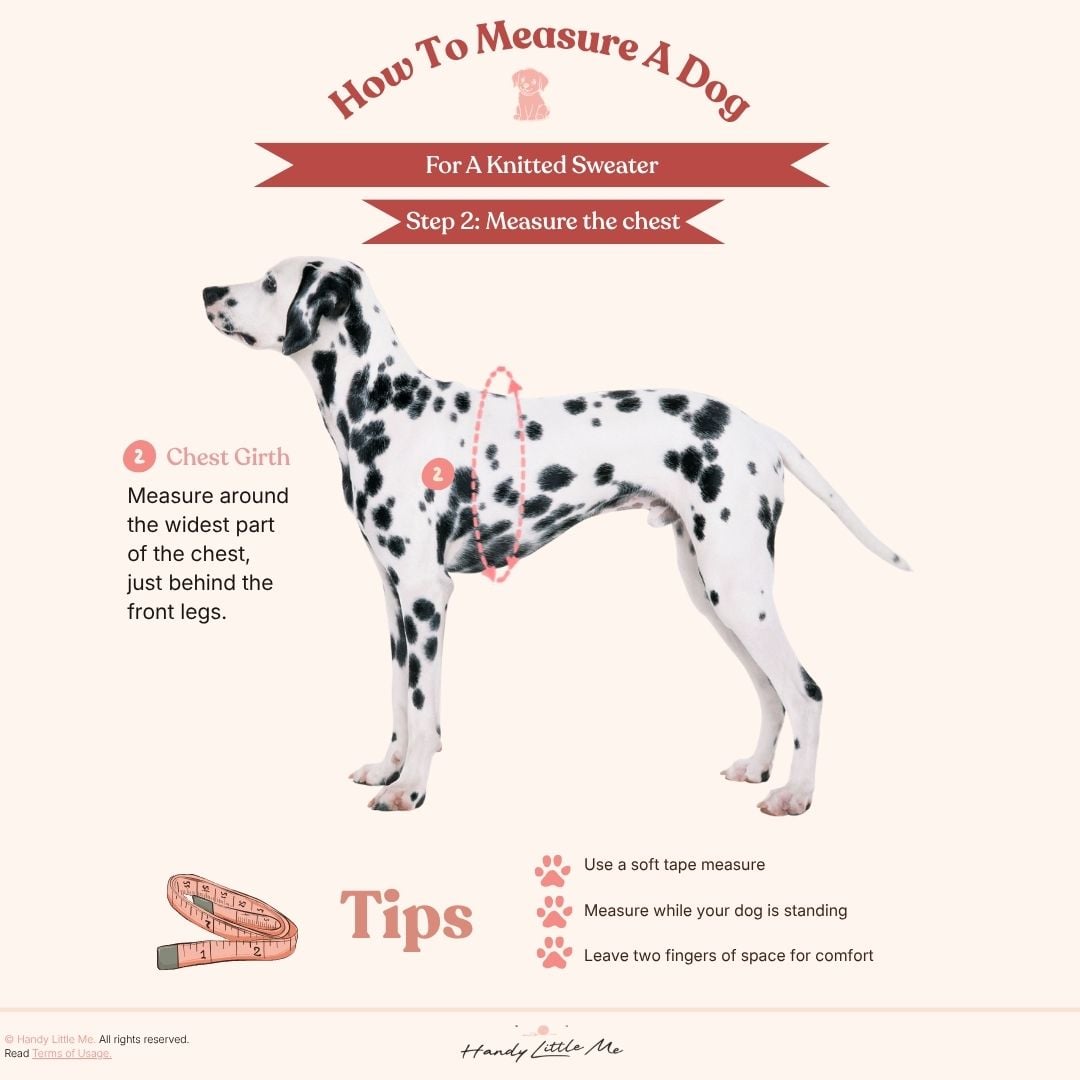
The chest girth is the circumference of your dog around the widest part of their chest.
This is usually just behind the front legs and around the ribcage.
Wrap the tape measure around the widest point of your dog’s chest, making sure it goes all the way around the body.
This girth measurement is one of the key measurements for choosing the right size.
For many dog sweater patterns, the chest measurement will decide the clothing size more than the back length.
This is especially important for breeds with different body types, like French bulldogs, dachshunds, small dogs, deep-chested dogs, or very slim dogs.
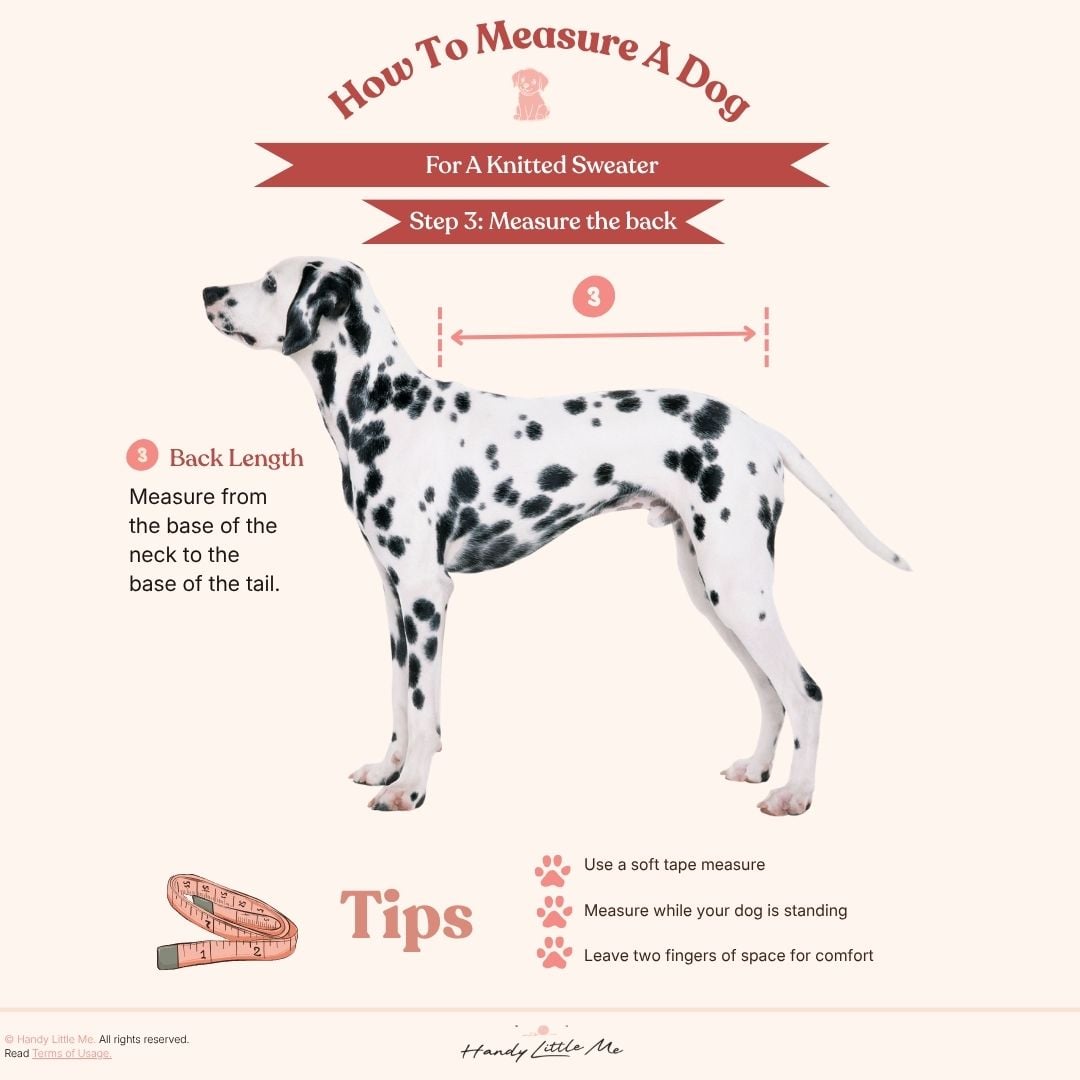
Step 3: Measure The Back Length
To measure the back length, start at the base of the neck and measure along the top of the dog’s body to the base of the tail.
The base of the neck is usually around the shoulder blades, where a collar would sit.
The base of the tail is where the tail joins the body.
This length measurement helps you know how long the sweater should be.
For a better fit, the sweater should cover your dog’s back without going so far that it gets in the way when your dog goes to the bathroom.
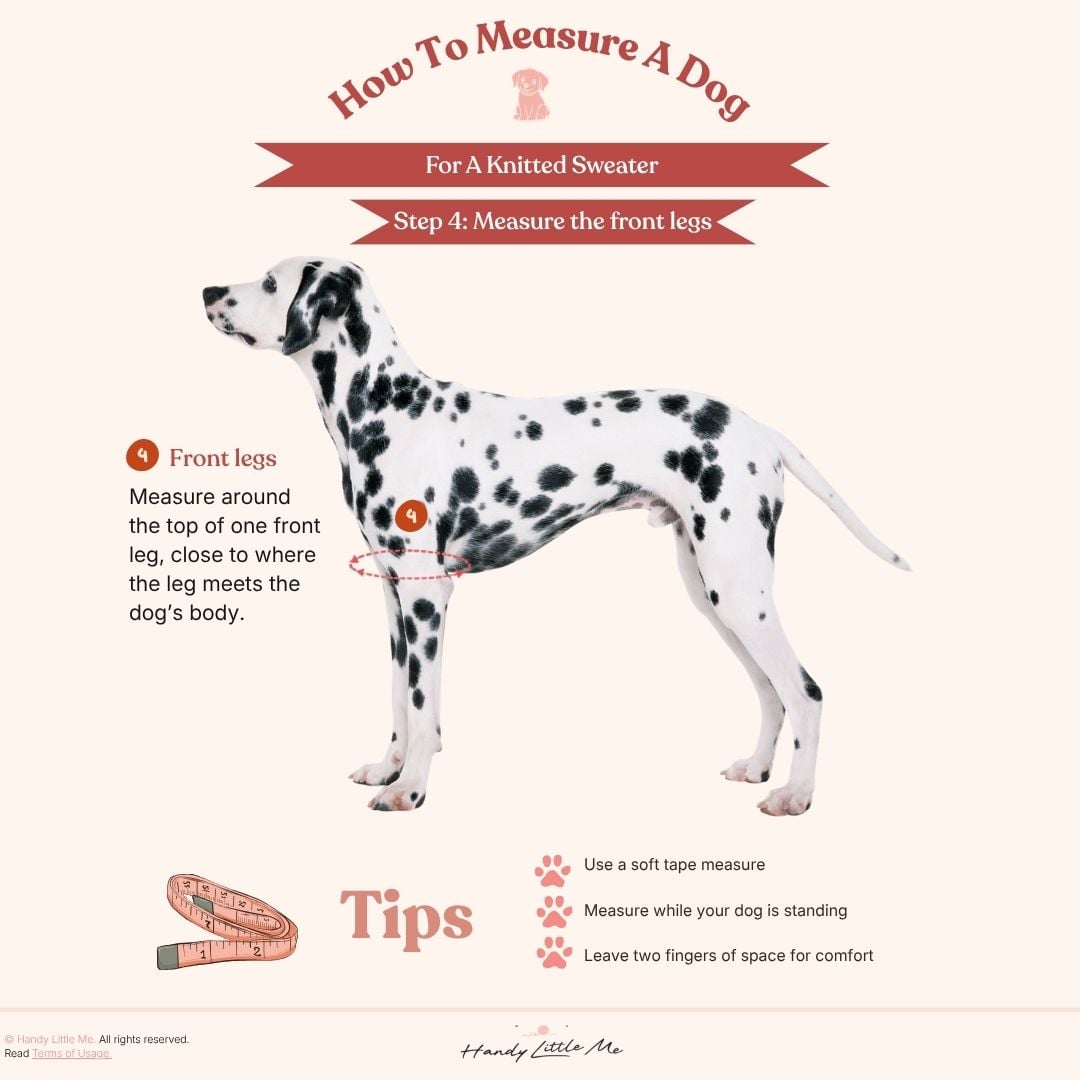
Step 4: Measure Around The Front Legs
For a knitted dog sweater, the front legs can be the trickiest part of measuring.
If the pattern has leg holes, you need to make sure there is enough room around the front legs for movement.
Measure around the top of one front leg, close to where the leg meets the dog’s body.
You can also measure the distance between the front legs if the pattern includes shaping across the chest.
This is important because a sweater that is too tight around the front legs can restrict movement and cause discomfort.
Your dog should be able to walk, stretch, and lie down without the sweater pulling.
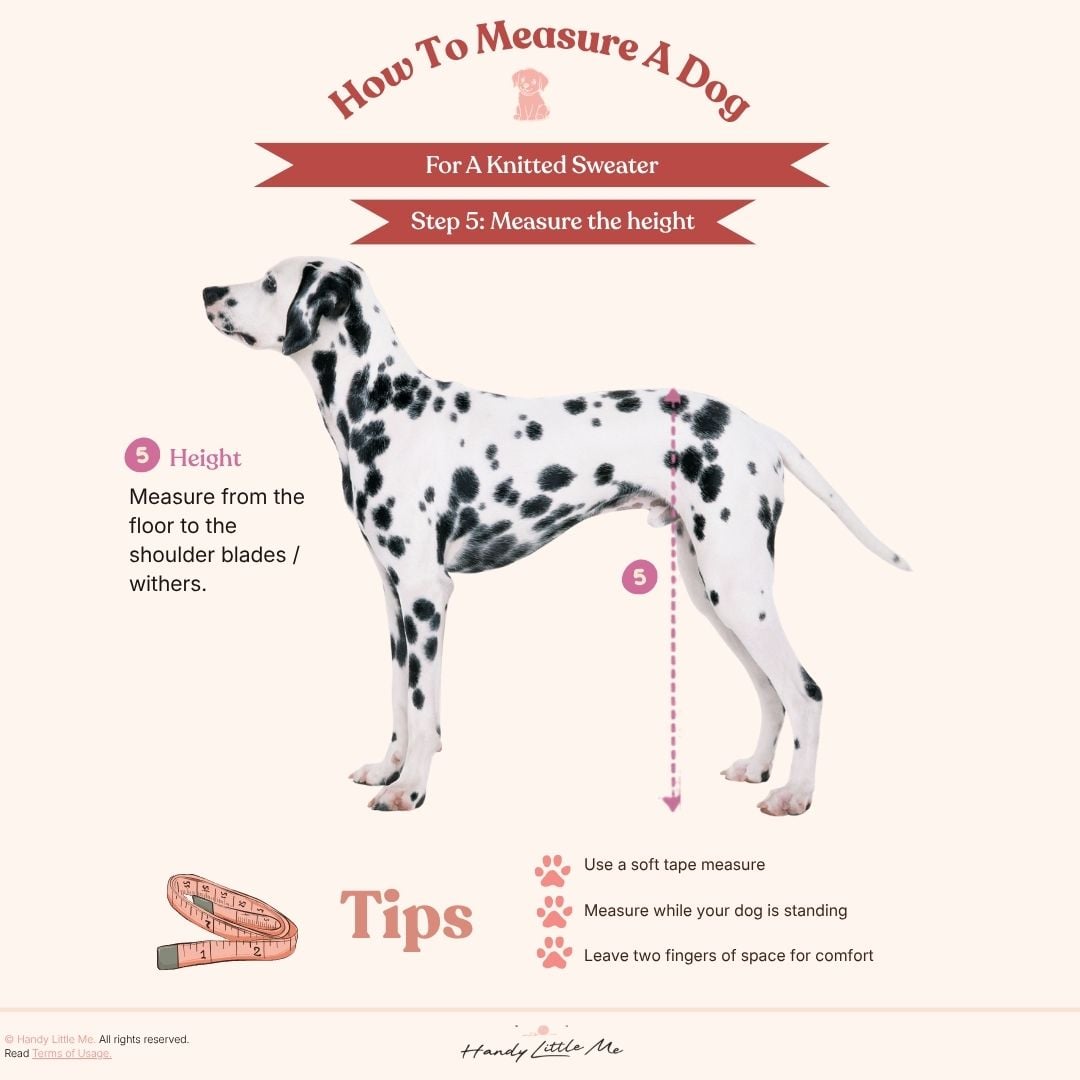
Step 5: Measure Your Dog’s Height
Some dog clothing size charts include dog heights, especially for coats, harnesses, or pet store sizing guides.
To take an accurate height measurement, have your dog stand on a flat surface.
Measure from the floor to the highest part of the dog’s shoulder blades, also called the dog’s withers.
The height of a dog is not always needed for a knitted sweater, but it can be helpful if you are comparing your dog’s measurements to a detailed sizing chart.
A dog’s height matters more for some types of dog clothes, harnesses, and coats than for simple sweaters.
Step 6: Check Your Dog’s Weight
Your dog’s weight can be useful when choosing between sizes, but it should not be the only measurement you use.
Two dogs can weigh the same but have very different body types.
For example, a French bulldog and a small terrier may have similar weights but completely different chest girth, neck measurement, and back length.
Use weight as a guide, but always compare it with the actual dog measurements.
The most accurate measurements will come from measuring your dog’s body directly.
How To Use A Size Chart
Once you have your dog’s measurements, compare them with the pattern size chart.
Look at the chest girth first, then the back length, then the neck measurement.
If your dog is between sizes, it is usually a good idea to choose the larger size, especially if your dog has a broad chest or thick fur.
You can always adjust the length slightly as you knit or crochet, but a too-small sweater may be uncomfortable.
A perfect fit should feel snug enough to stay in place but loose enough for your dog’s comfort.
How Much Ease Should A Dog Sweater Have?
A handmade dog sweater should not fit like a tight harness.
There should be enough room for your dog to move naturally.
Use the two-finger rule around the neck and chest.
You should be able to slip two fingers between the sweater and your dog’s body.
This gives a little extra space without making the sweater too loose.
If the sweater is too tight, it can cause great discomfort.
If it is too loose, it may slide around or become a potential danger if your dog’s paw gets caught.
Measuring Tips For The Best Fit
For the most accurate measurements of your dog, measure more than once.
Dogs wiggle, turn, and move, so it is normal to get slightly different numbers.
Here are a few tips for proper measuring:
- Measure your dog while they are standing.
- Keep the soft tape measure flat against the body.
- Do not pull the tape too tight.
- Measure the widest part of your dog’s chest.
- Measure from the base of the neck to the base of their tail.
- Write everything down clearly.
- Take photos of your dog from the side and front if you need help checking body shape.
- Photos of your dog can be helpful when comparing the measurements to a sweater pattern, especially if your pup has a long body, short legs, broad shoulders, or a deep chest.
What If You Don’t Have A Tape Measure?
If you do not have a soft tape measure, use a piece of string.
Wrap the string around the measurement points, mark the length with your fingers, and then measure the string with a ruler.
This is not always as easy as using a flexible measuring tape, but it works well for neck, chest, and length measurements.
Avoid using a stiff ruler directly around your dog’s body because it will not give precise measurements around curves.
Common Dog Sweater Fit Problems
Even with a size chart, handmade dog clothes may need small adjustments.
Here are some common signs of a poor fit:
- The neck is too tight.
- The chest pulls across the widest part of the dog.
- The front legs do not have enough freedom of movement.
- The back length is too long.
- The sweater twists to one side.
- The sweater slips off the shoulders.
- Your dog keeps trying to bite, paw, or shake it off.
- Improper fits can be uncomfortable, especially around the neck, chest, and legs.
If your dog seems unhappy in the sweater, check the fit before assuming they simply do not like wearing clothes.
Dog Sweater Fit vs Dog Harness Fit
Measuring for a dog sweater is similar to measuring for the right harness, but the fit is not exactly the same.
A good harness needs to be secure enough for better control and safety, while a sweater needs to be comfortable and flexible.
An ill-fitting harness or too-small harness can be a potential danger, but a too-tight dog sweater can also cause discomfort and restrict movement.
For sweaters, focus on warmth, comfort, and freedom of movement.
For harnesses, follow the harness sizing guide from the brand or pet store.

Extra Tips
Small Dogs
Small dogs often wear sweaters more often because they can get cold quickly.
When measuring small dogs, be extra careful around the chest and neck because even a small difference can affect the right fit.
A half inch or one centimeter can make a big difference in the final clothing size.
If you are making a sweater for a tiny dog, use precise measurements and check the pattern gauge carefully.
Broad-Chested Dogs
Some dogs, like French bulldogs, pugs, and other broad-chested breeds, may need extra room around the chest girth.
The widest part of your dog may be much larger than their back length suggests.
In this case, choose the size based on the widest part of their chest and adjust the length if needed.
This will give a better fit across the dog’s body and help avoid pulling around the front legs.
Final Fit Check
Once the sweater is finished, try it on your dog and check the fit before letting them wear it for long periods.
Look at these areas:
- Neck: Is there room for two fingers?
- Chest: Is the sweater snug but not tight?
- Front legs: Can your dog move freely?
- Back length: Does it stop before the base of the tail?
- Belly area: Is there enough room for comfort and bathroom breaks?
A well-fitting dog sweater should stay in place, keep your pup cozy, and allow natural movement.
The perfect size is not just about matching a size chart.
It is about using the right measurements for your dog’s body.
FAQ
- What is the most important measurement for a dog sweater?
The chest girth is usually the most important measurement for a dog sweater. Measure around the widest part of your dog’s chest, just behind the front legs.
- Where do I measure the back length?
Measure from the base of the neck to the base of the tail. The base of the neck is around the shoulder blades, where the dog collar usually sits.
- Should I size up for a dog sweater?
If your dog is between sizes, choosing the larger size is often a good idea. This gives enough room for movement and helps avoid a too-tight fit.
- How tight should a dog sweater be?
A dog sweater should be snug but comfortable. Use the two-finger rule around the dog’s neck and chest to make sure there is enough space.
- Can I use string instead of a tape measure?
Yes, you can use a piece of string if you do not have a soft tape measure. Wrap the string around your dog, mark the length, and then measure it with a ruler.
- Do I need my dog’s height for a sweater?
A dog’s height is not always needed for a knitted or crochet dog sweater, but it can be helpful when using detailed sizing charts or comparing different dog clothing sizes.
- How do I measure a dog that will not stand still?
Ask someone to help, use treats, and measure when your dog is calm. Take each measurement more than once to get the most accurate results.
Dog Sweaters To Make
- Free Dog Sweater Knitting Pattern (Straight Needles)
- Knitted Dog Sweater Pattern (3 Sizes To Knit For Free)
- Baby Yoda Pattern | Dog Sweater
- Large Dog Sweater Knitting Pattern (Free + Easy)
- Mischief Managed Dog Sweater Knitting Pattern
- Christmas Puppy Sweater Knitting Pattern
- Elf Dog Sweater Knitting Pattern (Free in 3 Sizes)
- Free Dog Sweater Pattern (Easy Knit Striped Coat)
- Cable Knit Dog Sweater Pattern (Knitted Turtleneck)
- Puppy Sweater Knitting Pattern (XS Puppy)
- Fraser Tartan Dog Sweater Pattern
- Dog Jumper Knitting Pattern – Rainbow Stripes
- 20 Beautiful Fall Dog Sweater Knitting Patterns
- Aran Dog Sweater Knitting Pattern