
Free Beret Knitting Pattern for Beginners (Knit Flat)
THIS ARTICLE CONTAINS AFFILIATE LINKS THAT SUPPORT HANDY LITTLE ME CONTENT AND FREE PATTERNS.This free beret knitting pattern is perfect for beginners who want to make a stylish handmade hat.
The beret is knitted flat with straight needles using simple knit, purl, increase, and decrease stitches. Once finished, it is seamed with mattress stitch to create a neat, nearly invisible join.
Made with worsted or Aran-weight yarn, this is a quick and satisfying project that you can knit in around two hours.
Scroll down for the free pattern, or purchase the inexpensive, printer-friendly, ad-free PDF from my shop.

About This Beret Knitting Pattern
This easy beret is worked flat from the bottom up, starting with a stretchy 1×1 ribbed brim.
After the brim, you will change to larger needles and increase the stitches to create the classic slouchy shape.
The main body is worked in stockinette stitch before a series of simple decreases shapes the top of the hat.
The remaining stitches are gathered together, and the back of the beret is joined using mattress stitch.
The pattern uses worsted or Aran-weight yarn and is designed to fit an average adult head measuring approximately 22–24 inches.

Pattern Overview
- Skill level: Basic beginner
- Construction: Worked flat and seamed
- Yarn weight: Medium 4/Worsted/Aran/10 ply
- Needles: 4 mm (US 6) and 5 mm (US 8) straight knitting needles
- Techniques used: Knit, purl, 1×1 ribbing, increasing, decreasing, and seaming
- Finished size: Fits an adult head measuring approximately 22–24 inches
- Finished diameter: Approximately 10 inches/26 cm
Is This Beret Suitable for Beginners?
Yes, this beret is a lovely first hat pattern for a beginner because it is knitted flat rather than in the round.
You will need to know how to cast on, knit, purl, increase, decrease, and seam your knitting.
However, the final stitches at the top of the beret are gathered together rather than cast off in the usual way.
If you are new to seaming, the mattress stitch creates a neat join that is almost invisible from the outside.
Inspired by the Clan Mackenzie Berets From Outlander
This knitted beret is part of my Outlander-inspired pattern collection and was influenced by the traditional Scottish berets worn by members of Clan Mackenzie.
It has just enough slouch to create the classic beret shape while still feeling comfortable and easy to wear on a cold day.
If you enjoy Outlander-inspired knits, you may also like my Scottish Beret Knitting Pattern and Skye Boat Knitted Beret Pattern.
Helpful Knitting Tutorials
If you are new to knitting, these tutorials will help you with the techniques used in this pattern:
- How to cast on knitting
- How to knit the purl stitch
- How to knit stockinette stitch
- Knitting abbreviations and terms (US and UK)
- The mattress stitch – how to seam knitting
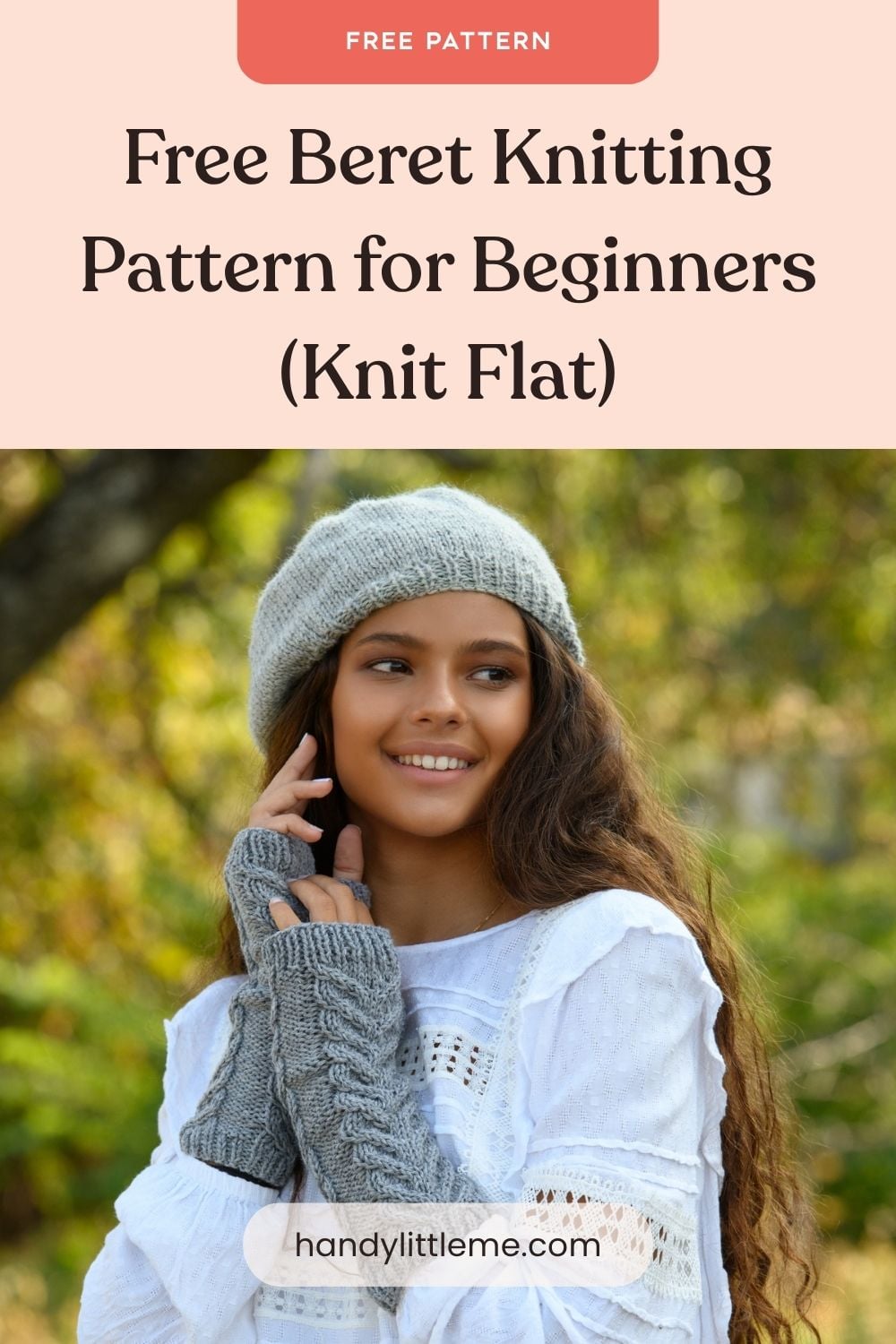
Free Beret Knitting Pattern
You can find the free pattern below, including the supplies, abbreviations, and complete row-by-row instructions.
You can also purchase the inexpensive, printer-friendly, ad-free PDF pattern from my shop.
The Ultimate Outlander Knitting Pattern Collection
Pattern Notes
Skill Level: Basic beginner
- The beret is worked flat from the bottom up and seamed at the back using mattress stitch.
- The brim is worked in 1×1 ribbing before increasing for the main body.
- The body and crown are worked in stockinette stitch, with decreases used to shape the top.
- When the knitting is finished, the remaining stitches are gathered together.
- Do not cast off the final stitches.
- The smooth stockinette side is the right side and will face outward when you wear the beret.
Size Information
Designed to fit an average adult head measuring approximately 22–24 inches.
- Finished diameter: Approximately 10 inches/26 cm
- Finished circumference of the brim: Approximately 18 inches/46 cm when relaxed
The ribbed brim stretches to fit comfortably around the head.
Gauge
18 stitches and 24 rows = 4 inches/10 cm in stockinette stitch using 5 mm (US 8) needles.
Check your gauge before beginning, particularly if you are substituting the recommended yarn.
Copyright Info
- Please do not copy, sell, redistribute, or republish this pattern.
- If you wish to share this pattern, link to the pattern page only.
- You may sell items produced using this pattern.
- Do NOT use copyrighted photos for your product listing.
- In all product listings, please credit Handy Little Me (Louise Bollanos) as the designer.
- For the copyright T&C, please read my Terms of Use.
Save this article
Enter your email address and we'll send it to your inbox.
By entering your email, you agree to receive patterns, tutorials, and updates from Handy Little Me. Unsubscribe at any time.
Supplies
Yarn
- 1 × 100g ball of Cascade 220 in Grey 8401
- Medium 4/Worsted/Aran/10-ply yarn
The original beret was made with 100% wool. You can substitute another worsted or Aran-weight yarn, but remember to check your gauge before beginning.
A wool or wool-blend yarn will give the beret warmth and help it hold its shape.
Needles
- 4 mm (US 6) straight knitting needles
- 5 mm (US 8) straight knitting needles
Notions
- Tape measure
- Darning or tapestry needle
- Scissors
Abbreviations
- Alt – Alternate
- Beg – Beginning
- Cont – Continue
- Foll – Following
- K – Knit
- K1, P1 rib – Knit one stitch and purl one stitch repeatedly across the row
- KFB – Knit into the front and back of the stitch to increase
- K2tog – Knit the next 2 stitches together
- P – Purl
- P2tog – Purl the next 2 stitches together
- Patt – Pattern
- St – Stitch (es)
- st st – Stockinette stitch
- Rem – Remaining
- Rep – Repeat
- Rib – work in ribbing K1, P1
- RS – Right side
- WS – Wrong side
Pattern Instructions
How to Knit a Beret With Straight Needles
- Cast on and knit the brim
With 4 mm (US 6) needles, cast on 80 sts.
Row 1 (RS): *K1, P1 rep from * to the end of the row.
Row 2 (WS): *K1, P1 rep from * to the end of the row.
Rep the last 2 rows 3 times more so that the piece measures 4 cm/1.5 inches from the cast-on edge.
- Knit the main body of the beret
Change to 5 mm (US 8) needles and work in patt as follows:
Next row: *K1, KFB – rep from * to the end of the row. (120 sts)
Starting with a P row, work in st st until the piece measures 5.5 inches/14 cm from the cast-on edge. - Decrease to shape the crown
Keeping continuity of patt – shape as follows:
Row 1: K1, *K2tog, K10: rep from * to end, K2tog, K9. (110 sts)
Row 2: This row and every alt row – Purl.
Row 3: K1, *K2tog, K9: rep from * to end, K2tog, K8. (100 sts)
Row 5: K1, *K2tog, K8: rep from * to end, K2tog, K7. (90 sts)
Row 7: K1, *K2tog, K7: rep from * to end, K2tog, K6. (80 sts)
Row 9: K1, *K2tog, K6: rep from * to end, K2tog, K5. (70 sts)
Row 11: K1, *K2tog, K5: rep from * to end, K2tog, K4. (60 sts)
Row 13: K1, *K2tog, K4: rep from * to end, K2tog, K3. (50 sts)
Row 15: K1, *K2tog, K3: rep from * to end, K2tog, K2. (40 sts)
Row 17: K1, *K2tog, K2: rep from * to end, K2tog, K1. (30 sts)
Row 19: K1, *K2tog, K1: rep from * to end, K2tog. (20 sts)
Row 20: *P2tog rep from * to the end of the row. (10 sts) - Finish and seam the beret
Do not cast off the remaining 10 stitches.
Cut the yarn, leaving a long tail for gathering and seaming. Thread the tail through a darning needle, then pass it through each of the remaining stitches while they are still on the knitting needle.
Carefully slide the stitches off the knitting needle and pull the yarn tail firmly to close the opening at the top of the beret. Fasten it securely on the wrong side.
With the right sides facing outward, use mattress stitch to join the two side edges and create the back seam.
Weave in any remaining loose ends.


How to Block a Knitted Beret
Blocking will help even out the stitches and give your finished hat its classic round beret shape.
Soak the beret in lukewarm water with a small amount of wool wash.
Gently squeeze out the excess water without wringing or twisting the knitting.
Place the beret over a dinner plate that measures approximately 10 inches/26 cm across.
Smooth the main body around the plate, keeping the ribbed brim beneath it so that the brim is not stretched.
Allow the beret to dry completely before removing it from the plate.

Share Your Finished Beret
I love seeing what you make!
If you knit this beret, I’d love to see your finished project.
You can tag me on Instagram @handylittleme or share a photograph in the Handy Little Me Facebook group.
Happy knitting!
More Free Outlander Knitting Patterns
If you enjoyed this pattern, you may also like:
- Outlander Carolina Shawl Pattern
- Claire’s Rent Shawl Knitting Pattern
- Outlander Brianna Fingerless Gloves Pattern
- Outlander Claire’s Cable Knit Wrist Warmers
- Outlander Cowl Knitting Pattern (Claire Season 1)
- Jenny’s Shawl Knitting Pattern (Outlander Knit)
- Journeycake Sontag Shawl Knitting Pattern
- Highlander Cable Knit Hat Pattern

Do you. Know the stitch numbers to make the ban slightly smaller? I made it as stated but it feels a little big. Thanks
Hello Diane,
To make the beret smaller you could try casting on 70 stitches or less – but you would have to work out the decreases from whatever number of stitches you decide to cast on.
Let me know how it goes!
Louise
Do I just do a knit 1 and purl 1 on the same row or do I do the knit 1 first and then purl 1 after the knit row for the Brim? ¿
Hello Dayna,
After you have worked the brim, you will start to work in stockinette stitch, the first row is a knit row, where you will increase, then the following row is a purl row.
You will then continue to work in stockinette stitch until the piece measures 5.5 inches.
I hope that helps!
Louise
Thank you Louise for your reply , I am working on the Beret hat right now!
OMGGG, Thank you I was wondering how to do the main body of the hat has im quite a newbie to the knitting world
thank you for the pattern but I loathe Outlander, it could have been so much better but the history is so, so poor like someone had two ideas and made up some cartoon nonsense to fill in between, it’s agony to watch, I buy the books second hand and throw them in the trash
Thanks for the reply. But if I cast off normally, how can I do this step:
Break yarn and thread through the rem sts, draw up tightly, and fasten off securely.
?
Great question! When the pattern says to “break yarn and thread through the rem sts, draw up tightly, and fasten off securely,” it’s usually referring to a method used when you’re left with just a few stitches—typically at the very top of the beret.
Instead of a traditional cast off (like you’d do at the edge of a scarf), you’ll want to cut the yarn, leaving a long enough tail, and use a yarn needle to thread that tail through the remaining stitches while they’re still on your needle. Then you pull the yarn tight like a drawstring to close the hole, and weave in the end securely on the inside. So no need to bind off the usual way—just gather the stitches up at the end.
Hope that helps clarify things!
My beret does not look like the picture you have….The purl stitches show more. Did I do something wrong?
Hi Hannah! Thanks for making the beret and for your note 😊
A few quick things to check when the purl bumps show more than in the photos:
Right side vs. wrong side: Make sure you’re looking at the stockinette (smooth knit) side as the outside. It’s easy to flip a beret inside out after blocking.
Blocking magic: A good block evens everything out. Soak, gently squeeze, then stretch over a dinner plate (RS facing out) so the top is smooth and the brim stays neat. Let it dry fully.
Tension/needles: If your purls are popping, your tension might be a touch snug. Next time you can try going up one needle size for the crown/body (keep the brim size the same) to relax the fabric.
Yarn choice: Very textured or lofty yarns can emphasize purl bumps. A smoother yarn gives a flatter, sleeker stockinette.
If you’d like, send a quick photo via email and tell me which yarn/needle size you used 💛🧶